BLOG
October 2, 2026
GWP IMMIGRATION LAW
There Is No Automatic Path Through Form N-600K
An interview is the default rule under Form N-600K, not an occasional extra step.
This post continues our October 1, 2026 guide to Form N-600K. It answers one narrow question: can the interview or oath ever be skipped.
Updated October 2, 2026 · GWP Law · Las Vegas, NVTHE CONTEXT
Is the N-600K Process Automatic Once You File?
No. N-600K is a naturalization application USCIS must adjudicate, and it generally requires an in-person interview.
Form N-600K exists because a child born abroad to a U.S. citizen parent does not always acquire citizenship automatically at birth.
A child who lives in the United States in a citizen parent’s legal and physical custody generally acquires citizenship on its own under the Child Citizenship Act, INA § 320, 8 U.S.C. § 1431.
A child who does not meet that residency test — most often because the family lives abroad — needs Form N-600K instead.
The form asks USCIS to naturalize that child under 18 under INA § 322, codified at 8 U.S.C. § 1433.
That is the key distinction from Form N-600, which only documents citizenship a person already holds — we cover that difference in detail in our N-600 vs. N-600K comparison.
Because N-600K is an application, not a record request, USCIS controls the pace and the steps between filing and a certificate.
As our October 1 guide to Form N-600K explains, that includes deciding whether the child must appear in person before approval becomes final.
Why the Child Must Be Physically Present
The same Policy Manual chapter requires the child to be lawfully admitted to, physically present in, and maintaining lawful status in the United States to complete naturalization.
That is the rule most families run into: their child lives abroad, so nothing about this process happens without a border crossing first.
There is one narrow exception, for children of U.S. armed forces members stationed abroad on official orders, who may complete the entire process — interview, oath, and all — outside the United States.
Outside that military exception, the child’s temporary, lawful admission to the U.S. is not optional paperwork; it is a legal precondition to the interview happening at all.
Will USCIS Waive the Interview?
Rarely. USCIS waives it only when eligibility is already proven by its own records or the documents filed.
The USCIS Policy Manual, Volume 12, Part H, Chapter 5 sets the general rule: the child, and the citizen parent if the child is under 18, must appear for an interview.
USCIS may waive that interview only in one of two narrow situations.
Either the documentation establishing eligibility is already in USCIS’s own administrative records, or the specific documentation required to prove eligibility was submitted with the application.
That is a narrow exception for cases USCIS can fully verify without seeing the family in person — it is not a general no-interview track, and families should not file expecting it.
In practice, this waiver tends to come up when USCIS already adjudicated a closely related case for the same family — for example, a sibling’s N-600K approval already on file with the same citizen parent’s records.
Most N-600K cases still receive an interview notice, because most families are submitting new evidence USCIS has not already verified on its own.
Who Must Appear, and What Is Being Verified
When an interview is scheduled, both the child and the U.S. citizen parent generally must appear together, not the child alone.
The officer is confirming the eligibility elements behind Form N-600K itself: the parent-child relationship, the citizen parent’s own citizenship and physical presence in the United States, and the child’s residence and custody abroad.
An interview notice is not a formality to reschedule at will, either.
If the child or parent does not appear and the interview is not rescheduled in advance, USCIS can treat the entire application as abandoned and deny it under 8 CFR 103.2(b)(13)(ii).
Does My Child Have to Take the Oath of Allegiance?
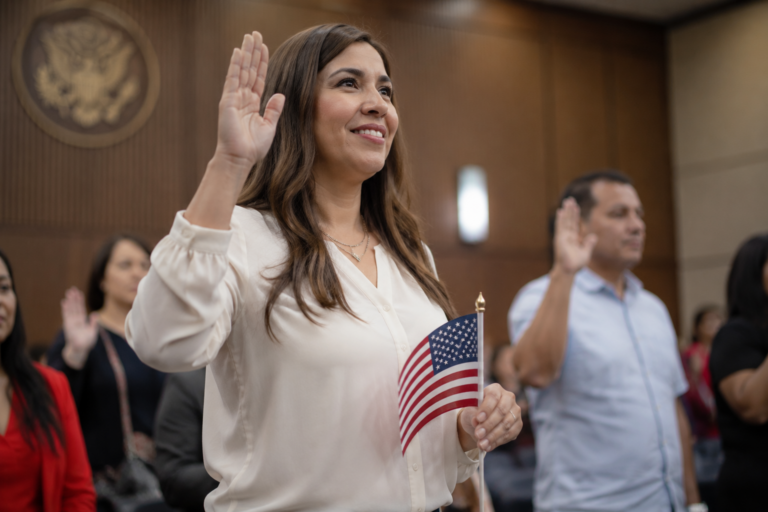
Children under 14 are exempt. Those 14 and older generally must take the oath before the certificate issues.
USCIS also requires the Oath of Allegiance before it issues the Certificate of Citizenship.
For children under 14, that oath is waived, because USCIS treats children that age as generally unable to understand its meaning.
For children 14 and older, the oath is the default rule, not the waiver.
USCIS may still waive it case by case, but only if the interviewing officer determines the specific child cannot understand what the oath means.
Most 14-and-older applicants should plan to take the oath, often on the same day as the interview if the case is approved on the spot.
The oath date itself becomes the official naturalization date printed on the Certificate of Citizenship.
Where the oath is waived — for a child under 14, or a specific case-by-case waiver for an older child — the certificate issues on the date USCIS approves that waiver instead.
Source: USCIS Policy Manual, Volume 12, Part H, Chapter 5. Online filing for Form N-600K became available through myUSCIS on January 29, 2019, per USCIS’s announcement, without changing the interview or oath rules above.
A REAL CASE
A Family That Assumed Filing Was the Finish Line
I reviewed a file for parents who had filed Form N-600K for their 15-year-old son, who lived with his grandmother abroad.
They assumed that once USCIS approved the case, a certificate would simply arrive in the mail.
Instead, the approval notice scheduled an in-person interview and oath ceremony at the Las Vegas field office.
Their son held no visa that would let him enter the United States for that appointment.
I helped the family prepare a B-1/B-2 visa application built around the interview notice itself as evidence of a specific, temporary purpose for travel.
He also carried proof of ties abroad: current school enrollment and his grandmother’s address as his residence.
I had the family schedule his visa interview at the U.S. embassy as soon as the USCIS notice arrived, since visa appointment wait times can run longer than the weeks USCIS gives between the notice and the interview date.
The consular officer approved the visa, he was admitted to attend his appointment, and USCIS administered the oath the same day his case was approved.
He received his Certificate of Citizenship before returning home.
His younger sister, filed on the same day at age 12, still needed her own interview, but her oath was waived because of her age.
Same family, same filing date, two different oath outcomes — because that rule turns on the child’s age, not the parents’ case.
What Families Should Prepare Before the Interview
THE PATH FORWARD
The Interview Timeline Is Why the 18th-Birthday Deadline Is Tight
Form N-600K is only available while the child is under 18, and every step above has to happen before that birthday.
Filing, an interview notice, a visa for the child if one is needed, the interview itself, and the oath for a child 14 or older all take real time on USCIS’s schedule, not the family’s.
None of that time compresses just because a family is running close to the child’s 18th birthday.
Our satellite guide on what happens if your child turns 18 while N-600K is pending walks through that timing risk directly.
Building in the visa step early, rather than after the USCIS interview notice arrives, is what keeps that timeline from running out.
The practical takeaway here is narrower: plan for an interview, plan for a possible oath, and plan for the travel logistics behind both, rather than assuming any of them away.
References
- INA § 320, 8 U.S.C. § 1431 — Cornell Law School Legal Information Institute
- INA § 322, 8 U.S.C. § 1433 — Cornell Law School Legal Information Institute
- USCIS Policy Manual, Volume 12, Part H, Chapter 5
- INA § 214(b), 8 U.S.C. § 1184(b) — Cornell Law School Legal Information Institute
- 8 CFR 106.2(b)(8) — Electronic Code of Federal Regulations
- 8 CFR 103.2(b)(13)(ii) — Electronic Code of Federal Regulations
- U.S. Department of State, Fees for Visa Services
- USCIS, online filing announcement
- USCIS Processing Times
Preparing for an N-600K interview or oath appointment?
GWP Immigration Law can help you plan the filing, the interview, and the travel logistics behind it.
Book a Consultation →This article is for informational purposes only and does not constitute legal advice. Consult a qualified immigration attorney before taking any action. · Last verified: October 2, 2026 · Reviewed by: Kathia Quirós, Immigration Attorney · GWP Immigration Law