BLOG
July 23, 2026
GWP IMMIGRATION LAW
What Happens If I Get Denaturalized? Your Family’s Citizenship Isn’t Automatically at Risk
In most fraud-based cases, yes for children — but a spouse’s own naturalization is rarely affected.
Civil denaturalization filings jumped from historical levels of well under one per month to dozens filed in May and June 2026 alone, following a 2025 Department of Justice enforcement memo. For families who built their status around one person’s naturalization, the outcome for a child or spouse now depends entirely on which ground the government uses and how that family member’s own status was obtained.
Updated July 23, 2026 · GWP Law · Las Vegas, NVTHE CONTEXT
Why This Matters Now
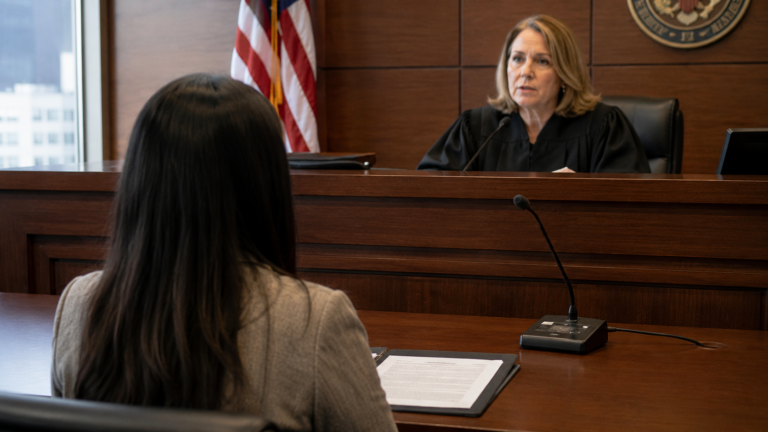
Denaturalization is a federal court proceeding, not a USCIS decision. USCIS can investigate and refer a case, but only a U.S. district court — through a civil suit or a criminal conviction — can actually revoke citizenship.
On June 11, 2025, the DOJ Civil Division directed its attorneys to “prioritize and maximally pursue denaturalization proceedings in all cases permitted by law,” listing ten categories of priority cases in its Civil Division Enforcement Priorities memo. That memo builds on a standing Denaturalization Section the DOJ created in 2020, dedicated specifically to these cases.
The result is measurable. According to a June 2026 TRAC report, the government filed 15 civil denaturalization complaints in May 2026 and 18 more in the first half of June 2026, compared with a historical average of under one per month going back to 2008.
Almost all of these are civil cases under 8 U.S.C. § 1451(a). A criminal conviction under 18 U.S.C. § 1425 works differently: the sentencing court automatically revokes the naturalization as part of the same judgment, with no separate civil suit required.
The government’s burden of proof remains high in every case. Civil revocation requires evidence that is “clear, unequivocal, and convincing,” and once that burden is met, courts have no discretion to excuse the conduct, under the Supreme Court’s holding in Fedorenko v. United States, 449 U.S. 490 (1981).
Civil denaturalization also carries no fixed filing deadline. 8 U.S.C. § 1451(a) sets none, so a naturalization from decades ago can still be reopened today.
Source: 8 U.S.C. § 1451(d).
Most people assume “derived citizenship” covers both a naturalized citizen’s spouse and their children. Under current law, it almost never does for a spouse.
A child under 18 who is a lawful permanent resident living with a naturalized parent acquires citizenship automatically, without filing anything, under the Child Citizenship Act of 2000, codified at 8 U.S.C. § 1431. That automatic acquisition is exactly what 8 U.S.C. § 1451(d) reaches when a parent’s naturalization is revoked.
A spouse, by contrast, almost always naturalizes through their own Form N-400 after three years of marriage-based permanent residence. Because that citizenship was independently granted, it is not something they “claim through” the other spouse’s naturalization, and 8 U.S.C. § 1451(d) does not reach it automatically.
Read our earlier post on why timing and accuracy matter when you apply for citizenship for the filing side of this same risk.
A REAL CASE
A Case From Our Files
A father called our office after receiving a letter referencing an old arrest he had not listed on his N-400 twenty years earlier.
I pulled his file and the arrest record. The charge had been dismissed, but the N-400 question asked about any arrest, not just convictions.
His wife had naturalized on her own five years after him, based on their marriage, so her citizenship did not depend on his case at all.
His teenage son, however, had automatically acquired citizenship as a child living with him at the time he naturalized, which meant the son’s status was directly tied to the outcome of the father’s case.
I focused on materiality: an omitted, dismissed arrest does not automatically disqualify anyone from naturalization, so the omission would need to have concealed something that “would predictably have disclosed” an actual disqualifying fact, under the standard set in Maslenjak v. United States, 582 U.S. 335 (2017).
We responded to DOJ with the arrest disposition and the father’s otherwise-clean record before any complaint was filed.
What To Do If You or a Family Member Is Contacted
THE PATH FORWARD
Accuracy Now Protects Your Family Later
Denaturalization is being pursued far more aggressively in 2026 than in any year since the DOJ began tracking it, but the legal standard has not changed. The government still needs clear, unequivocal, convincing evidence, and a single dismissed charge or minor omission rarely meets that bar on its own.
What has changed is the volume of cases being opened, which means old paperwork is being revisited for entire families, not just the person who signed the N-400.
If your children derived their citizenship through you, or if you are unsure whether your own naturalization file is complete, a review now is far less costly than a defense later. Naturalized citizens are treated differently than citizens by birth, whose status cannot be revoked through this process, which is exactly why the details of your original filing still matter years afterward.
References
- 8 U.S.C. § 1451 — Revocation of Naturalization, Cornell Legal Information Institute: law.cornell.edu/uscode/text/8/1451
- USCIS Policy Manual, Vol. 12, Part H, Ch. 4 — Automatic Acquisition of Citizenship (Child Citizenship Act / INA 320): uscis.gov
- U.S. Department of Justice, Civil Division Enforcement Priorities memo (June 11, 2025): justice.gov
- TRAC, “Denaturalization Lawsuits Jump in May and June 2026” (June 17, 2026): tracreports.org
- 18 U.S.C. § 1425 — Procurement of Citizenship or Naturalization Unlawfully
- 8 CFR Part 340 — Revocation of Naturalization
- Fedorenko v. United States, 449 U.S. 490 (1981)
- Maslenjak v. United States, 582 U.S. 335 (2017)
- USCIS Policy Manual, Vol. 12, Part L, Ch. 1 — Purpose and Background
- U.S. Department of Justice, press release on the creation of the Denaturalization Section (Feb. 26, 2020)
Have questions about your naturalization file or a family member’s status?
Our attorneys review naturalization records and respond to DOJ and USCIS inquiries before they become court filings.
Book a Consultation →This article is for informational purposes only and does not constitute legal advice. Consult a qualified immigration attorney before taking any action. · Last verified: July 23, 2026 · Reviewed by: Kathia Quirós, Immigration Attorney · GWP Immigration Law