A Big Court Says: Detained Immigrants Get a Hearing After 90 Days
GWP Immigration Law, LLP | Las Vegas, Nevada | Explaining the Sosnava Rodriguez v. Ortega ruling in plain English
A federal court called the Fifth Circuit made this ruling on July 2, 2026.[2]
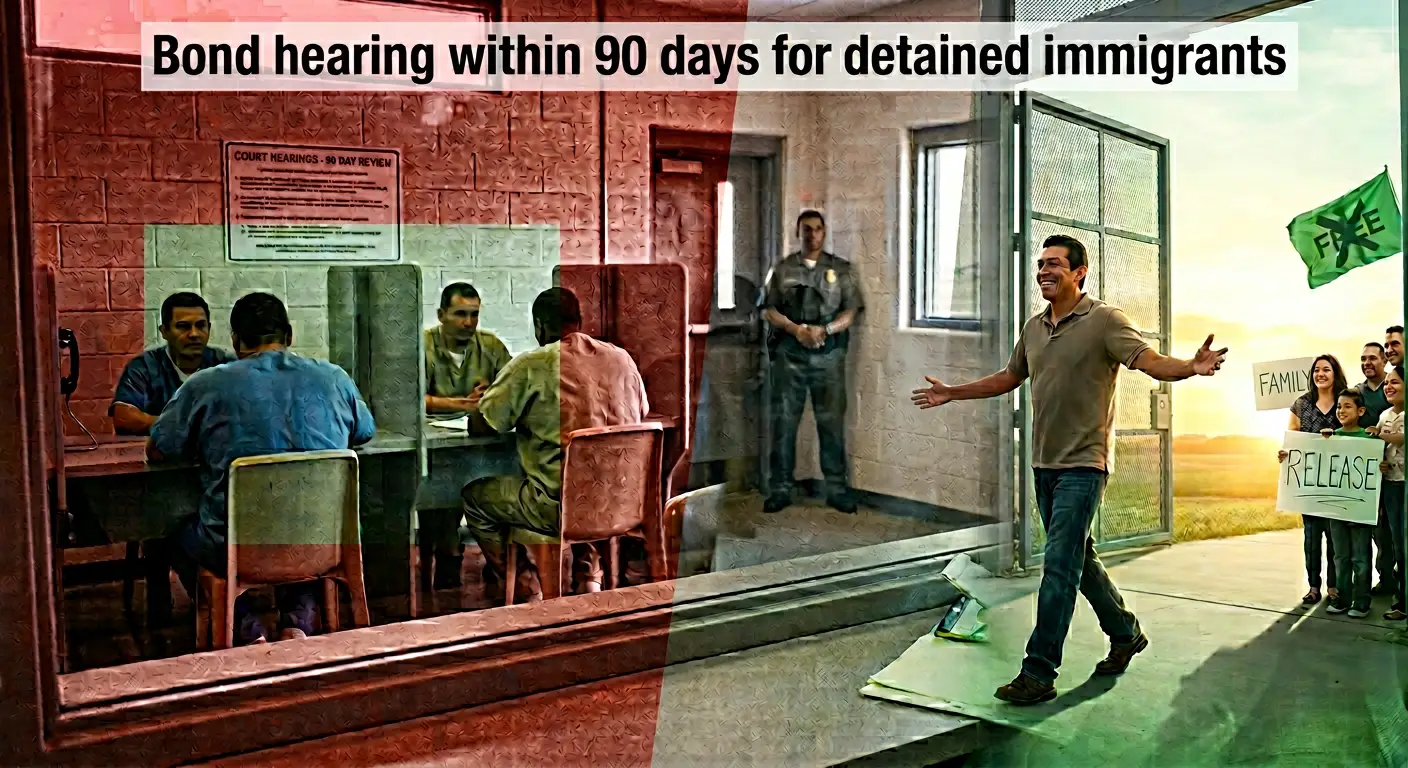
Detained immigrants can now get a bond hearing after 90 days — a court just said the government cannot lock someone up forever without ever explaining why. On July 2, 2026, three judges on a court called the Fifth Circuit made a big decision. They said: if the government wants to keep holding an immigrant in custody for more than 90 days, it must give that person a hearing.[2] At a hearing, a judge listens to both sides before deciding something important.
Detention — being held by the government, not free to leave.
Bond hearing — a meeting where a judge decides if a detained person can be released while their case continues.
Due process — the idea that the government must follow fair steps before it takes away someone’s freedom.
Habeas corpus — an old legal tool that lets a detained person ask a judge, “Why am I locked up? Prove it.”[35]
How This Started
For almost 30 years, the government treated people two different ways.[5] If someone had lived in the U.S. for a long time without legal papers, they could ask a judge for release on bond while their case moved forward.[9,14] In July 2025, the government changed its mind. It said: no more bond hearings for people who entered the country without permission — no matter how long they had lived here.[11]
The Case Before This One
In February 2026, this same court agreed the new rule followed the words of the law.[4] That case is called Buenrostro-Mendez v. Bondi. Since the law itself didn’t help them anymore, three men tried a different argument: even if the law allows no bond hearings, the U.S. Constitution still requires one.
Meet the Three Men
All three men had lived in the U.S. for over 10 years. None had a criminal record. All are fathers of children born in the United States.
- Ignacio Sosnava Rodriguez — came to the U.S. in 2004. Police stopped him for a broken headlight on December 23, 2025. He was released on February 27, 2026.[2]
- Alejandro Villegas Angel — came to the U.S. in 2011. Stopped for driving without a license on February 10, 2026. Released March 5, 2026.[2]
- Miguel Angel Gomez Alvarado — came to the U.S. in 2012. Detained after a traffic stop on November 13, 2025. Released March 5, 2026.[2]
None of the three men actually reached 90 days — a lower court freed them first. The new rule matters most for people still detained today.[2]
What the Judges Said
Three judges heard this case: Judge Southwick, Judge Graves, and Judge Wilson. They did not all agree.
The government argued that a person who lived here for 20 years should be treated the same as someone caught right at the border. Judge Southwick rejected that idea in blunt words: it “is more than a convenient legal fiction. It is a complete fantasy.”[16]
Judge Graves agreed with the outcome but thought 90 days was too long to wait. He would have picked 30 days instead. He wrote about “an appalling lack of humanity shown to our fellow human beings.”[30,33]
Judge Wilson disagreed with the whole ruling. He wrote that the new rule “deputizes every district court” to rewrite immigration law and will bring “even more chaos” to already-overloaded courts.[51]
The New Rule: Bond Hearing After 90 Days Explained
- A person held under this law must get a bond hearing within 90 days.[35]
- At that hearing, the government must give a real reason — usually that the person is dangerous or a flight risk.[35]
By the Numbers
Judge Wilson’s dissenting opinion (the part where he disagreed) pointed to older government numbers to argue that people often skip their court dates. These numbers come from the government’s side of the argument, not from the majority opinion:
Old “no-show” numbers are contested and come from the government’s side of the case, cited in the dissent, not the majority’s own findings.[59,60]
What This Means For You and Your Family
If someone you love has been held by ICE in Texas, Louisiana, or Mississippi for more than 90 days without a hearing, this ruling gives them a real, concrete right to ask for one. It does not promise they will be released. It promises they get to stand in front of a judge and make their case.
Do you have a family member detained without a hearing?
At GWP Immigration Law, we look at your case, check if this ruling applies, and move fast — because in detention, every day counts.
Call us at 702-737-77178942 Spanish Ridge Ave, Suite 1, Las Vegas, NV 89148 | 702-737-7717 | gwp.law
About the Author
Kathia Quirós, Esq. is the founder and owner of GWP Immigration Law, LLP, a Las Vegas, Nevada law firm practicing at the intersection of immigration, estate planning, and family law. She is also the host of Inmigrando con Kathia, a daily program that helps Spanish-speaking immigrant families across the United States understand their rights. Kathia and her team regularly track federal court rulings like this one so their clients don’t have to.
GWP Immigration Law, LLP
8942 Spanish Ridge Ave, Suite 1
Las Vegas, NV 89148
Phone: 702-737-7717
Website: gwp.law
Related reading on our site: more immigration law updates from GWP.
Legal Citations (60) — For Attorneys and Researchers
All 60 items below come from inside the actual slip opinion in Sosnava Rodriguez v. Ortega, No. 26-50183 (5th Cir. July 2, 2026) — either as page cites to the opinion itself, or as real cases, statutes, and reports the opinion cites. Only citations with a verified, working link are shown as links; the rest are listed as plain-text legal citations rather than risk a broken or misdirected link.
- U.S. Const. amend. V.
- Sosnava Rodriguez v. Ortega, No. 26-50183 (5th Cir. July 2, 2026) (slip op.), consolidated w/ Nos. 26-50219 & 26-50221.
- Zadvydas v. Davis, 533 U.S. 678, 693–94 (2001).
- Buenrostro-Mendez v. Bondi, 166 F.4th 494 (5th Cir. 2026).
- 8 U.S.C. § 1225(b)(2)(A).
- 8 U.S.C. § 1225(a)(1).
- 8 U.S.C. § 1226(a).
- 8 U.S.C. § 1226(c).
- Jennings v. Rodriguez, 583 U.S. 281, 286 (2018).
- Landon v. Plasencia, 459 U.S. 21, 25–26 (1982).
- Matter of Yajure Hurtado, 29 I. & N. Dec. 216, 227–29 (BIA 2025).
- Immigr. & Customs Enf’t, Interim Guidance Regarding Detention Authority for Applications for Admission (July 8, 2025).
- 8 C.F.R. § 1236.1(c)(8).
- 8 C.F.R. § 1003.19(d).
- Nielsen v. Preap, 586 U.S. 392, 397 (2019).
- Wong Wing v. United States, 163 U.S. 228, 238 (1896).
- Plyler v. Doe, 457 U.S. 202, 212 (1982).
- Shaughnessy v. United States ex rel. Mezei, 345 U.S. 206, 212 (1953).
- Yamataya v. Fisher, 189 U.S. 86, 94 (1903).
- Mathews v. Diaz, 426 U.S. 67, 77 (1976).
- DHS v. Thuraissigiam, 591 U.S. 103, 114–15 (2020).
- Nishimura Ekiu v. United States, 142 U.S. 651, 660 (1892).
- Hohn v. United States, 524 U.S. 236, 252–53 (1998).
- Shalala v. Ill. Council on Long Term Care, Inc., 529 U.S. 1, 18 (2000).
- Leng May Ma v. Barber, 357 U.S. 185, 190 (1958).
- Cleveland Bd. of Educ. v. Loudermill, 470 U.S. 532, 541 (1985).
- Arnett v. Kennedy, 416 U.S. 134, 167 (1974) (Powell, J., concurring).
- Connecticut Dep’t of Public Safety v. Doe, 538 U.S. 1, 5 (2003).
- Reno v. Flores, 507 U.S. 292, 306 (1993).
- Mills v. Rogers, 457 U.S. 291, 299 (1982).
- Smith v. Org. of Foster Fams. for Equal. & Reform, 431 U.S. 816, 847 (1977).
- Washington v. Glucksberg, 521 U.S. 702, 708 (1997).
- Foucha v. Louisiana, 504 U.S. 71, 86 (1992).
- Hamdi v. Rumsfeld, 542 U.S. 507, 532 (2004).
- Carey v. Piphus, 435 U.S. 247, 259 (1978).
- Kansas v. Hendricks, 521 U.S. 346, 356 (1997).
- Demore v. Kim, 538 U.S. 510, 531 (2003).
- Black v. Decker, 103 F.4th 133, 159 (2d Cir. 2024).
- Genalo v. Black, No. 25-886, 2026 WL 1718025 (U.S. June 15, 2026).
- Lopez-Campos v. Raycraft, 175 F.4th 713, 732–33 (6th Cir. 2026).
- United States v. Salerno, 481 U.S. 739, 748 (1987).
- Carlson v. Landon, 342 U.S. 524, 536 (1952).
- Fiallo v. Bell, 430 U.S. 787, 792 (1977).
- County of Riverside v. McLaughlin, 500 U.S. 44, 57–58 (1991).
- Jones v. United States, 463 U.S. 354, 361 (1983).
- Addington v. Texas, 441 U.S. 418, 425 (1979).
- Mullane v. Central Hanover Bank & Trust Co., 339 U.S. 306, 313 (1950).
- The Bd. of Regents of State Colleges v. Roth, 408 U.S. 564, 569–70 (1972).
- Boddie v. Connecticut, 401 U.S. 371, 379 (1971).
- Barry v. Barchi, 443 U.S. 55, 72 (1979) (Brennan, J., concurring in part).
- Mathews v. Eldridge, 424 U.S. 319, 333 (1976).
- Gomes v. Garite, No. EP-25-CV-00663-DCG, 2026 WL 1179617 (W.D. Tex. Apr. 21, 2026).
- Martinez v. Holder, 693 F.3d 408, 413 n.5 (3d Cir. 2012).
- Torres v. Barr, 976 F.3d 918, 928 (9th Cir. 2020) (en banc).
- Avila v. Bondi, 170 F.4th 1128, 1133 (8th Cir. 2026).
- Logan v. Zimmerman Brush Co., 455 U.S. 422, 436 (1982).
- Dep’t of State v. Muñoz, 602 U.S. 899, 909–11 (2024).
- Monsalvo v. Bondi, 604 U.S. 712, 714 (2025).
- Nat’l Fed’n of Indep. Bus. v. Sebelius, 567 U.S. 519, 570 (2012).
- Banyee v. Garland, 115 F.4th 928, 933–34 (8th Cir. 2024).
- H.R. Rep. No. 104-469, at 122, 159 (1995) (cited in dissent).
- 62 Fed. Reg. 10312, 10323 (Mar. 6, 1997) (cited in dissent).
Further reading (verified links): Constitutional Accountability Center case page · American Immigration Council case summary · SCOTUSblog: Genalo v. Black