BLOG
July 16, 2026
GWP IMMIGRATION LAW
The 2026 Public Charge Rule Is Final: What Changes September 18
DHS rescinded the 2022 public charge regulation today, restoring broad discretion to immigration officers over green card and visa decisions.
Every family- and employment-based green card applicant now faces a “totality of the circumstances” review with fewer regulatory guardrails than at any point since 2022 — and, for nationals of 75 countries, a State Department visa pause already in litigation. Here is what actually changes, and what does not.
Updated July 16, 2026 · GWP Law · Las Vegas, NVTHE CONTEXT
Why the Public Charge Rule Matters Now
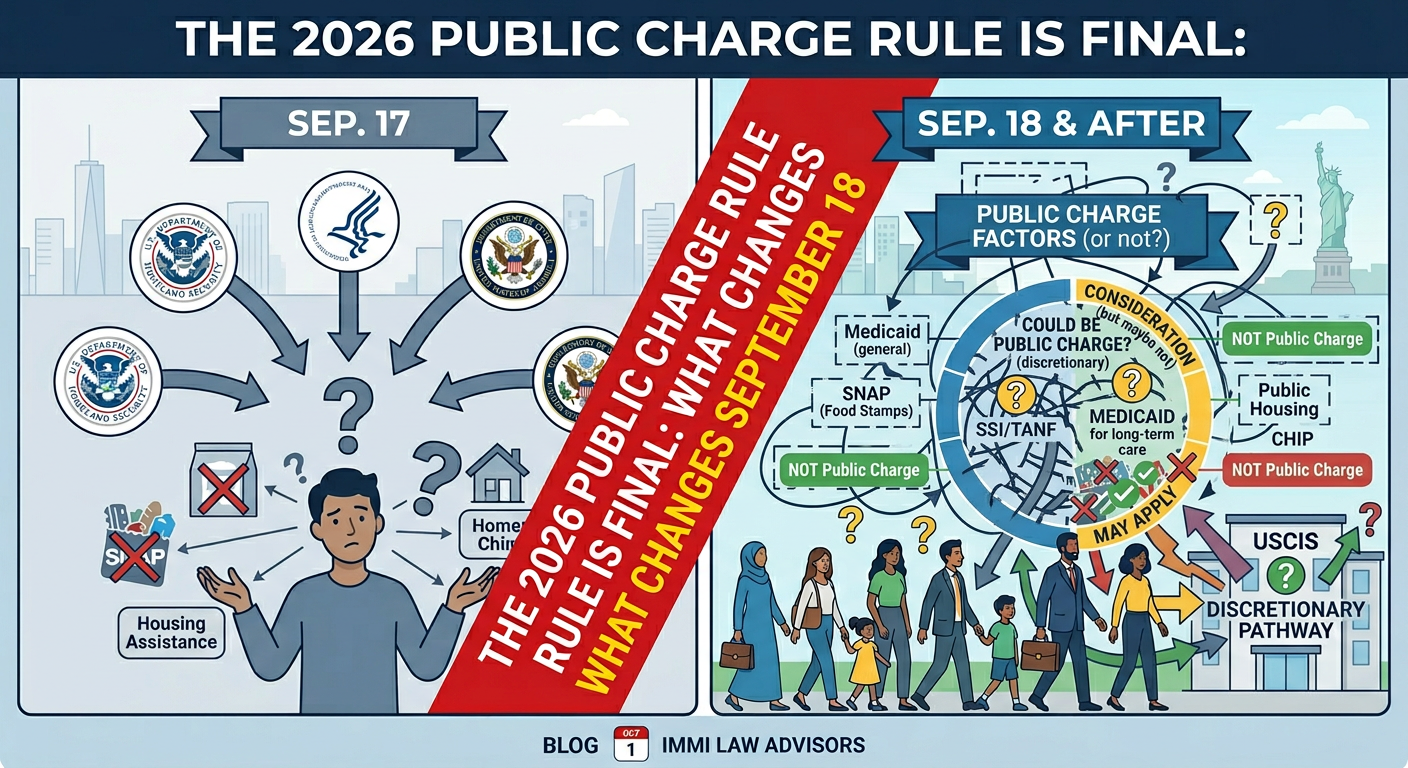
On July 16, 2026, the Department of Homeland Security published a final rule rescinding the 2022 Public Charge Ground of Inadmissibility regulation, the framework that has governed adjustment of status filings for the past four years. USCIS confirms the rule takes effect September 18, 2026, and that a revised Form I-485 will be required — older editions filed on or after that date will be rejected outright, no exceptions for a form that was correct the week before. In short, the 2026 public charge rule resets the standard everyone will be measured against.
This did not appear overnight. DHS previewed the shift with Policy Memorandum PM-602-0190 in September 2025, which reminded officers that a public charge determination is “inherently subjective in nature” with “no bright-line test,” and formalized the proposal on November 19, 2025 through a Notice of Proposed Rulemaking (90 FR 52168, RIN 1615-AD06). The 2022 rule had narrowly defined “public charge” as primary dependence on cash assistance or long-term institutionalization, and explicitly excluded non-cash benefits like Medicaid and SNAP from the analysis. The 2026 public charge rule sweeps that narrow definition away.
That narrow definition is now gone. Officers return to weighing age, health, family status, assets and resources, education and skills, and the sufficiency of the Form I-864 Affidavit of Support — all “in the totality of the circumstances,” with no single factor automatically controlling except an insufficient affidavit.
The regulatory change runs alongside a separate and more disruptive action: since January 21, 2026, the State Department has indefinitely paused issuance of immigrant visas to nationals of 75 countries it designates “high risk” for public benefits use — interviews continue, but consular officers withhold the visa and issue a Section 221(g) refusal instead. That policy is already being tested in court, including in our own backyard.
Twelve months of public charge policy change, September 2025 – September 2026.
Source: USCIS, “USCIS Rescinds 2022 Public Charge Regulation,” July 16, 2026; U.S. Department of State.
A REAL CASE
A Family Petition From the Paused List
A man called our office not long ago about his wife’s I-130 case. She was a national of one of the 75 countries on the State Department’s list, consular processing was already underway, and he had read online that the pause meant the case was effectively dead. It wasn’t.
We reviewed the file and found she qualified to convert to adjustment of status once she entered the U.S. on a valid nonimmigrant visa, which is unaffected by the pause and processed entirely through USCIS rather than a consular post abroad. We also verified her Affidavit of Support against current household income to preempt a request for evidence under the totality-of-the-circumstances standard in PM-602-0190. The visa pause remains in effect for consular cases from her country of origin as of this writing, but her case is now moving through a track it does not touch.
What to Do Now
Source: USCIS, Form I-485; PM-602-0190.
THE PATH FORWARD
A Rule With More Discretion, and More Room to Litigate
Broader officer discretion cuts both ways. It means more room for an experienced attorney to build a complete, well-documented case before an officer ever has to guess — but it also means less predictability for anyone who files without one.
The new public charge rule is also not the last word: a Nevada federal court has already enjoined the Department of State from applying the 75-country pause to two individual plaintiffs in Sangster v. Rubio, and a broader challenge, CLINIC v. Rubio, is pending in the Southern District of New York.
A related nationality-based USCIS policy was vacated entirely in Dorcas International Institute of Rhode Island v. USCIS on June 5, 2026, though the government has appealed that ruling to the First Circuit. None of this guarantees an outcome for any individual case — it means the landscape between now and September 18 is still being decided in court, not just in the Federal Register.
References
- USCIS, “USCIS Rescinds 2022 Public Charge Regulation,” July 16, 2026.
- Federal Register, “Public Charge Ground of Inadmissibility,” 90 FR 52168, Nov. 19, 2025.
- USCIS, Policy Memorandum PM-602-0190, “Reaffirming Guidance on Public Charge Inadmissibility Determinations,” Sept. 4, 2025.
- U.S. Department of State, “Immigrant Visa Processing Updates for Nationalities at High Risk of Public Benefits Usage,” Jan. 14, 2026.
- Immigration Policy Tracking Project, Sangster v. Rubio, No. 3:25-cv-0047 (D. Nev.).
- National Immigration Law Center, CLINIC v. Rubio, filed Feb. 2, 2026 (S.D.N.Y.).
- USCIS, “Court Order on Hold Policies,” re: Dorcas International Institute of Rhode Island v. USCIS, June 5, 2026.
Filing before September 18 — or affected by the 75-country pause?
Talk to our team before you submit anything. A short consultation now can prevent a rejected filing or a stalled case later.
Book a Consultation →This article is for informational purposes only and does not constitute legal advice. Consult a qualified immigration attorney before taking any action. · Last verified: July 16, 2026 · Reviewed by: Kathia Quirós, Immigration Attorney · GWP Immigration Law